Indian Banquet Halls in Nj for Baby Shower
A baby shower is a political party of souvenir-giving or a ceremony that has dissimilar names in dissimilar cultures. It celebrates the delivery or expected nascency of a kid or the transformation of a woman into a female parent.

Etymology [edit]
The term shower is frequently assumed to mean that the expectant mother is "showered" with gifts. A related custom, chosen a conjugal shower, may have derived its name from the custom in the 19th century for the presents to be put within a parasol, which when opened would "shower" the bride-to-exist with gifts.[1] Alternatively the term possibly denotes a "first showing" of the new baby to the wider family unit and circle of friends, although the baby shower is usually held earlier the birth of the baby.
Description [edit]
Traditionally, babe showers are given but for the family unit'southward beginning child, and simply women are invited,[2] though this has inverse in recent years, at present allowing showers beingness split up for unlike audiences: workplace, mixed-sex activity, etc.[3] Activities at infant showers include gift-giving and playing themed games.
Baby shower games vary, sometimes including standard games such every bit bingo, and sometimes being pregnancy-themed, such as "gauge the mother's measurements" or "estimate the baby". These games help the close friends attend the shower bond with the mother and enable the new family to say thank you alee of fourth dimension, figuring out who is willing and able to help them with the challenges of bringing upwards.
Co-ordinate to etiquette authority Miss Manners, because the political party centers on gift-giving,[4] the baby shower is typically bundled and hosted by a shut friend rather than a fellow member of the family unit, since information technology is considered improper for families to beg for gifts on behalf of their members.[v] However, this custom varies by culture or region and in some it is expected and customary for a close female family member to host the babe shower, oft the babe'south maternal grandmother.[6]
When a baby shower is held after a infant's birth, an invitation to attend the shower may be combined with a baby announcement. In the US, if a baby shower does not happen before the inflow of the baby, a sip-and-see party or other similar events can be organized afterwards the nativity.
Gifts [edit]
Guests bring small gifts for the expectant mother. Typical gifts related to babies include diapers, blankets, infant bottles, clothes, and toys. It is common to open the gifts during the political party; sometimes the host will make a game of opening gifts.
Family bonding [edit]
The infant shower is a family's first opportunity to get together people together to help play a part in their child'south life. The new parents may wish to call on people to assist in the upbringing of their child, and help brainwash the child over time. People around the family, who treat them, want to be involved in the child's life, and a baby shower presents an opportunity for them to requite gifts and exist of help, showing their dear for the family.[vii] If it happens earlier the birth, it allows the new family to thank anybody before the stress of a new babe and lack of sleep begins.
History [edit]

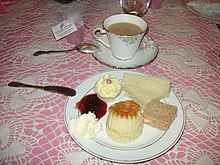
Baby shower shortbread biscuits
The term "babe shower" is relatively new, just the celebrations and rituals associated with pregnancy and childbirth are both ancient and enduring.[8]
- Ancient India
- In Bharat, a pregnancy ritual has been followed since the vedic ages: an effect chosen seemantha, held in the sixth or 8th calendar month. The female parenthoped-for is showered with dry fruits, sweets and other gifts that help the baby's growth. A musical event to please the infant's ears is the highlight of the ritual, as information technology was common cognition that the infant's ears would offset operation within the womb. The ritual prays for a healthy baby and mother, besides as a happy delivery and maternity.
- Ancient Egypt
- In ancient Egypt, rituals relating to the birth of a child took place after the upshot itself. Quite unlike modernistic baby showers, this involved the female parent and the kid existence separated to "incorporate and eliminate the pollution of nascency" – this may have included visiting local temples or shrines. After this, at that place may also take been household rituals that took place, just the specifics have been found hard to study as these are such female-centered events.[eight]
- Ancient Hellenic republic
- The ancient Greeks also celebrated pregnancy subsequently the nascence, with a shout (oloyge) later the labor has concluded, to indicate that "peace had arrived". Five to seven days later, at that place is a ceremony called Amphidromia, to indicate that the baby had integrated into the household. In wealthy families, the public dekate ceremony, later on ten days, indicated the mother'south return to society. (The ten-day catamenia is all the same observed in modern-twenty-four hour period Islamic republic of iran.)[eight]
- Medieval Europe
- Due to the likelihood a mother would dice in childbirth, this time was recognized as having a bully risk of spiritual danger in improver to the risk of physical danger. Priests would frequently visit women during labor so they could confess their sins. After the nascence, usually on the aforementioned day, a baptism ceremony would take place for the baby. In this anniversary, the godparents would requite gifts to the child, including a pair of silver spoons.[8]
- Renaissance Europe
- Pregnancies at this time were celebrated with many different kinds of birth gifts: functional items, like wooden trays and bowls, as well as paintings, sculptures, and food. Childbirth was seen equally well-nigh mystical, and mothershoped-for were often surrounded with references to the Declaration by mode of encouragement and celebration.[8]
- Victorian Britain and North America
- Superstitions sometimes led to speculation that a woman might be pregnant, such as 2 teaspoons being accidentally placed together on a saucer. Gifts were usually paw-made, but the grandmother would requite argent, such as a spoon, mug, or porringer. [8] In Uk, the manners of the upper-class (and, afterward, heart-form) required pregnancy to be treated with discretion: the failing of social invitations was often the only hint given. Subsequently the birth, a monthly nurse would be engaged, whose duties included regulating visitors. When the nanny took over, the mother began to resume normal domestic life, and the resumption of the weekly 'at home' afternoon tea an opportunity for female friends to visit. The Christening - usually held when the child was between 8-12 weeks old - was an of import social event for the family, godparents and friends.
- Modernistic Due north America
- The modern babe shower in America started in the late 1940s and the 1950s, equally mail-war women were expecting the Infant Boom generation. As in before eras, when immature women married and were provided with trousseau, the shower served the function of providing the mother and her dwelling with useful material appurtenances.[8]
While continuing the traditions from the 1950s, modern technology has altered the grade a baby shower takes: games tin can include identifying baby parts on a sonogram. Moreover, although traditional baby showers were female-exclusive, mixed-sex showers have increased in frequency.[8]
In dissimilar countries [edit]

Baby showers and other social events to celebrate an impending or recent nativity are popular around the earth. They are often women-just social gatherings.
- In Australia, Canada, New Zealand, and the United States, baby showers are a common tradition.
- In Brazil, a party called "chá de bebê" (baby tea) is offered earlier birth.
- In Bulgaria, every bit a superstition, no infant gifts are given to the family earlier the baby's nascency. However, family and friends give or ship unsolicited gifts to the newborn baby, fifty-fifty if some babies are kept from the public for the first 40 days to forestall early infections.
- In Chinese tradition a baby shower, manyue (满月), is held i month after the infant is born.
- In Hmong civilization, a baby shower is called "Puv Hli", and is held ane calendar month after the babe is born. A ceremony would be hosted by the paternal grandparents or the male parent to welcome the baby to the family by tying the baby's wrist with white yarn and/or strings.
- In Armenia, a infant shower is called "qarasunq" (քառասունք) and is celebrated twoscore days subsequently the birth. It is a mixed political party for all relatives and friends. Guests usually bring gifts for the infant or parents.
- In Iran, a baby shower (Persian:حمام زایمان) is likewise called a "sismooni political party" (Persian:جشن سیسمونی). It is celebrated one–iii months earlier the baby'southward nascence. Family and close friends give gifts intended for the baby such equally a cot, toys, and babe dress.
- In Costa Rica, a baby shower party is chosen té de canastilla ("basket tea"), and multiple events are held for a unmarried pregnancy for the family, co-workers, and friends.
- In Nepal, a baby-shower party is called "dahi-chiura" (दही चिउरा) and is celebrated in the sixth or seventh month of pregnancy.
- In Mongolia, a infant shower is called "хүүхдийн угаалга" (huuhdyn ugaalga).
- In Hindu tradition, they are called by different names depending on the family unit's community.
- In northern India information technology is known as godbharaai (filled lap), in the Punjab region, information technology is also known every bit "reet".In western India, specially Maharashtra, the commemoration is known every bit dohaaljewan, and in W Bengal and Odisha it is called saadhroshi. In W Bengal, in many places a political party named "sadh" (সাধ) or "sadhbhokkhon" (সাধভক্ষণ) is observed on the seventh month of pregnancy. After this, the woman resides in her male parent's firm instead of her married man's until the nascence.
- In southern Republic of india, in Tamil Nadu and Andhra Pradesh it is chosen seemantham, valaikaapu or poochoottal. The expecting mother wears bangles and is adorned with flowers.
- In Karnataka information technology is chosen seemanta(ಸೀಮಂತ) or kubasa (ಕುಬಸ). It is held when the woman is in her 5th, seventh, or 9th month of pregnancy.
- In coastal Karnataka, especially in Tulunadu (Tulu speaking region), the ceremony is as well known as "baayake" ('ಬಾಯಕೆ'). Baayake in Tulu means desire. It is popularly considered that pregnant women crave fruits and commons during the pregnancy catamenia; and the anniversary was designed in the olden days to fulfill the desire or food cravings of the motherhoped-for.
- Although these might be celebrated together, they are very different: seemantham is a religious ceremony, while valaikappu and poochoottal are purely social events much like Western infant showers. In a valaikappu or poochoottal, music is played and the expectant mother is decked in traditional attire with many flowers and garlands fabricated of jasmine or mogra. A swing is decorated with flowers of her selection, which she uses to sit down and swing. At times, symbolic cutting-outs of moons and stars are put up. The elderly ladies from the household and customs shower blessings on the expectant female parent and gifts are given to her.
- In Gujarat, it is known as seemant or kholo bharyo, a religious ritual for most Gujarati Hindus during the 5th or 7th calendar month of pregnancy, usually only for the outset child. The expectant mother can only go to her begetter's house for delivery after her seemant. They offer special prayer and food to the goddess "Randal, the wife of the Sunday".
- In Jain tradition, the baby shower ceremony is often called every bit "Shreemant". The expectant female parent can go to her begetter's business firm in the fifth month of pregnancy and has to come back before the baby shower ceremony. After the ceremony the expectant mother cannot go back to her father'south firm. The ceremony is only performed on Sun, Tuesday or Thursday of the 7th or ninth month of pregnancy. During the ceremony one of the practise is that the younger brother-in-police force of the expectant female parent dips his hands in Kumkuma water and slaps the expectant mother seven times on her cheeks and then the expectant female parent slaps her younger brother-in-law seven times on his cheeks.
- In Kerala it is known equally pulikudi or vayattu pongala', and is expert predominantly in the Nair community, though its popularity has spread to other Hindu sects over the years. On an auspicious day, later on being massaged with homemade ayurvedic oil the woman has a customary bath with the help of the elderly women in the family unit. After this, the family unit deity is worshipped, invoking all the paradevatas (family deities) and a batter of herbal medicines prepared traditionally, is given to the woman. She is dressed in new clothes and jewellery used for such occasions. A big difference in the western concept of baby shower and Hindu tradition is that the Hindu ceremony is a religious ceremony to pray for the baby'south well-being. In well-nigh bourgeois families, gifts are bought for the motherhoped-for but not the baby. The babe is showered with gifts only later nascence.
- In the Islamic tradition of Aqiqah, an animal (such every bit a sheep) is slaughtered anytime afterwards the birth, and the meat is distributed among relatives and the poor. The practise is considered sunnah and is not done universally.[9] [x]
- In South Africa, a baby shower is called a stork party (named after the folk myth that a white stork delivers babies), and typically takes place during the female parent's 6th calendar month. Stork parties, usually not attended by men and oft organized as a surprise for the mother, involve silliness such as dressing up, and mothers receive gifts of infant supplies.
- In Nepal a baby shower is known every bit "dahi chiura khuwaune". The motherhoped-for is given gifts from her elders and a meal is cooked for her according to her preferences. The meaning mother is often invited by her relatives to swallow meals with them. Pasni is a traditional celebration that oftentimes marks a baby boy's 6th month or a baby girl'southward fifth month, marking the transition to a nutrition higher in carbohydrates and allowing guests to bequeath blessings, and money and other gifts.
- In Guatemala, only women attend this event. Middle-class women usually celebrate more than ane baby shower (ane with close friends, co-workers, family, etc.).
- In Russian federation, and Commonwealth of Independent States, there are no baby showers, though some of the younger generation are starting to adopt the custom.
- In Egypt a infant shower is known equally " Sebouh " (سبوع) (sebouh means week) which is ordinarily celebrated one week after nativity hence its name. This is usually historic with a DJ, much decoration, a nutrient and candy cafe, activities and games.
- In Puerto Rico, a baby shower is celebrated anytime after other family members are made aware of the pregnancy, simply typically during the terminal trimester. The grandmother, sisters, or friends of the pregnant mother organize the commemoration and invite other relatives and friends. It is not mutual for men to attend baby showers. The "bendición" (blessing) is bestowed money and other gifts.
Babe showers for fathers [edit]
Some baby showers are directed at fathers. These may be more oriented towards drinking beer, watching sports, line-fishing, or playing video games.[11] [12] The primary nature of these gifts is diapers and/or diaper-related items.[13] [14] The organization of the diaper party is typically done past the friends of the father-to-exist as a mode of helping to prepare for the coming child. These parties may exist held at local pubs/confined, a friend's house, or the soonhoped-for grandfather's house.[thirteen] [15] In the United kingdom, this is called wetting the baby'south head, and is mostly more mutual than baby showers. Yet, with the growth of American cultural influence- accelerated through celebrities via social media sites similar Instagram, baby showers are condign more common in the United Kingdom. [16] Wetting the baby's head is traditionally when the father celebrates the birth past having a few drinks and getting drunkard with a group of friends.
There has been some controversy over these, with Judith Martin calling them a "monstrous imposition",[14] although she was referring to the mental attitude of demanding gifts and not necessarily the male version of a baby shower.
In Hungary, such an event is chosen Milking party held by tradition in favor of the female parent to exist blessed with breast milk for the newborn. Practically it is the last 24-hour interval-off of the male parent for some time as he is expected to stay dwelling house to help. No like domestic custom exists for mothers, such as a infant shower. Gifts for the baby are given on the first visit to his/her home. This due to health concerns happens at the advisable and suitable time for each counterpart.
Names for events [edit]

A buffet at a babe shower, featuring an appropriately themed block.
- Diaper shower refers to a small-scale baby shower, generally for subsequent children, when the parents don't need as many baby supplies.[17]
- Grandma's shower refers to a shower at which people bring items for the grandparents to continue at their firm, such equally a collapsible crib and a changing pad.[xviii]
- Sprinkles are small showers for a subsequent child, particularly a child who is of a unlike gender than the previous offspring.[19]
- A sip and see political party is a commemoration unremarkably planned by the new parents, then that friends and family tin sip on refreshments and meet the new baby.
Run across also [edit]
- Gender reveal party
- Motherhood package (or babe box), some other way for parents to acquire the necessities for their first child
- Postpartum confinement, a ready of community for mother and baby immediately following the birth
- Simantonnayana, a Hindu ritual like to a baby shower
References [edit]
- ^ Montemurro, Beth (2006). "Origins of Conjugal Showers and Bachelorette Parties". Something Old, Something Assuming . Rutgers Academy Press. pp. 26. ISBN0-8135-3811-4.
- ^ Robin Elise Weiss (2009). The Complete Illustrated Pregnancy Companion . 153: Off-white Winds. pp. 320. ISBN978-1616734435.
infant shower history and tradition.
{{cite book}}: CS1 maint: location (link) - ^ "The History of Babe Showers". www.parentingpage.com . Retrieved 2021-03-07 .
- ^ William Haviland; Harald Prins; Dana Walrath; Bunny McBride (2013). Anthropology: The Homo Challenge. 456: Cengage Learning. p. 784. ISBN978-1285677583.
{{cite book}}: CS1 maint: location (link) - ^ Martin, Judith (10 September 2010). "Miss Manners: Modesty is the all-time political party policy". The Washington Mail service.
- ^ Xiaowei Zang (2012). Agreement Chinese Social club. 25: Routledge. p. 208. ISBN978-1136632709.
{{cite book}}: CS1 maint: location (link) - ^ "Why to Have Baby Showers?". The Pregnancy Zone . Retrieved 2018-01-13 .
- ^ a b c d e f g h "Ritual and Ceremony: A History of Infant Showers". world wide web.randomhistory.com. Archived from the original on 2015-xi-03. Retrieved 2015-11-04 .
- ^ The sacred meadows : a structural analysis of religious symbolism in an East African town / by Abdul Hamid One thousand. el Zein.
- ^ 'Raise your voices and kill your animals' : Islamic discourses on the Idd el-Hajj and sacrifices in Tanga (Tanzania) : authoritative texts, ritual practices and social identities / by Gerard C. van de Bruinhorst total text
- ^ "Fathers-to-be get their ain babe showers male fashion". TribLIVE. 2011-ten-03. Retrieved 2012-07-31 .
- ^ "It's buddies, beers and diapers". StarTribune.com. 2011-07-08. Retrieved 2012-07-31 .
- ^ a b Yadegaran, Jessica (2011-09-25). "Home & Garden | Diaper parties: Dad-to-be's respond to baby showers | Seattle Times Newspaper". Seattletimes.nwsource.com. Archived from the original on 2013-01-30. Retrieved 2012-07-31 .
- ^ a b Martin, Judith (2009-01-28). "Miss Manners: Diaper political party is beyond the pail - Houston Chronicle". Chron.com. Retrieved 2012-07-31 .
- ^ Tjader, Aimie. "Information technology's buddies, beers and diapers". Seattle Times. Retrieved 2012-07-31 .
- ^ Kate Fox (2008). Watching the English: The Hidden Rules of English language Behaviour . London: Nicholas Brealey Publishing. ISBN978-ane-85788-508-eight.
- ^ BabyCenter, Editors of; Murray, Linda J.; Scott, Jim; Leah Hennen (2005-06-22). The BabyCenter Essential Guide to Pregnancy and Nascence: Practiced Advice and Existent-World Wisdom from the Top Pregnancy and Parenting Resource . Rodale. p. 346. ISBN9781594862113 . Retrieved 3 February 2013.
- ^ Hill, Sabrina (2010-09-30). Everything Baby Shower Book: Throw a memorable event for female parent-to-be. Adams Media. pp. 133–144. ISBN9781440524455 . Retrieved 3 February 2013.
- ^ Vora, Shivani (ix December 2012). "For Babe No. 2 or 3, No Shower but a Sprinkle". The New York Times. p. 12. Retrieved 3 February 2013.
External links [edit]
 | Look up baby shower in Wiktionary, the free dictionary. |
-
 Media related to Baby shower at Wikimedia Commons
martinanobaciping.blogspot.com
Source: https://en.wikipedia.org/wiki/Baby_shower
0 Response to "Indian Banquet Halls in Nj for Baby Shower"
Post a Comment